When it comes to language learning apps, Duolingo is definitely the most famous one.
I’d always heard they used AI on their platform.
After looking into it, I found out they actually introduced a pretty cool algorithm called Half-Life Regression (HLR). The algorithm can dynamically predict exactly when a user is about to forget a word and then remind the user right at that moment.
Sounds super reasonable. We forget things and we need to review.
But exactly how much do we forget, and how fast? This brings us to the famous “Forgetting Curve” study.

According to this curve:
- People forget about 50% – 80% of what you learned within just one day.
- After 7 days, only about 2-3% of information left in our brain.
The first time I saw this curve, my immediate thought was, “Well, I might as well pack my bags and go home,” because it looked like humans literally can’t remember anything.
But that feels a bit counterintuitive, doesn’t it? Reading this, you probably think, “My memory isn’t that bad.”
Actually, the name “Forgetting Curve” is just too catchy, so people often forget about the second curve (yes, there are more than one curves).
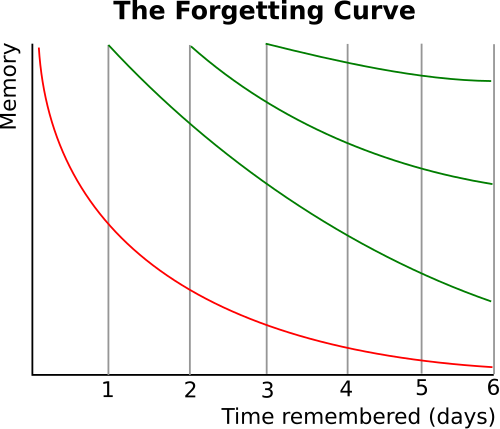
Let’s just call this second one the “Reviewing Curve.” Simply put: “If you review every day, you remember it better.”
Aside from that, the curve gets “flatter” after the first, second, and third day.
This means the more we review, the longer it takes to forget.
This is exactly what Duolingo is doing.
Every once in a while, when the Green Owl thinks you are about to forget, it gives you a nudge.
The academic term for this process is called “Spaced Repetition.”
Now, let’s talk about a more effective way to review called “Retrieval Practice” or “actively recall”
If one just stare at a flashcard, thinking “æble is apple, apple is æble” —that’s almost completely useless.
Even worse, it creates an illusion that you have already memorized it.
But if you force yourself to recall “the 10 words I memorized this morning,” or challenge yourself to “spell out æble,” you have to wake up more neurons and use more brainpower.
The more brainpower you use to dig that word out of your memory maze, the more solid the memory becomes.
To sum it up, the effective way to memorize words is to “do complex active recall at specific intervals.” For example:
- Learn the words in the morning.
- Recall them before bed.
- Recall them again the next morning.
- Give yourself a little quiz.
Through this process, the neural circuits will consolidate, making it harder and harder to forget.
===
A Little Bit More about the Forgetting Curve:
When scientists created this experiment, they asked participants to memorize random numbers or letters. Basically, it was just noise—meaningless and completely disconnected from the real world.
But in daily life, the things we memorize aren’t just meaningless noise. We can speak them out loud (audio signals), see colors (visual signals), smell them (olfactory signals), understand why they exist (social context), and we can even like or dislike them (emotional cue). All of these help us remember.
Although we might not have deep feelings for every vocabulary we learn, we can still use things like pronunciation, roots, and prefixes to boost our memory.
Leave a Reply